A buyer orders the medium in navy. The package that shows up is a large in gray. The buyer opens a return, eBay counts it against the seller's metrics, and the seller goes back to the listing trying to figure out what happened. Nine times out of ten, the answer is boring: the variation structure was built by copying the supplier's option list straight into eBay without checking whether every option actually mapped to the right image, the right price and the right stock status.
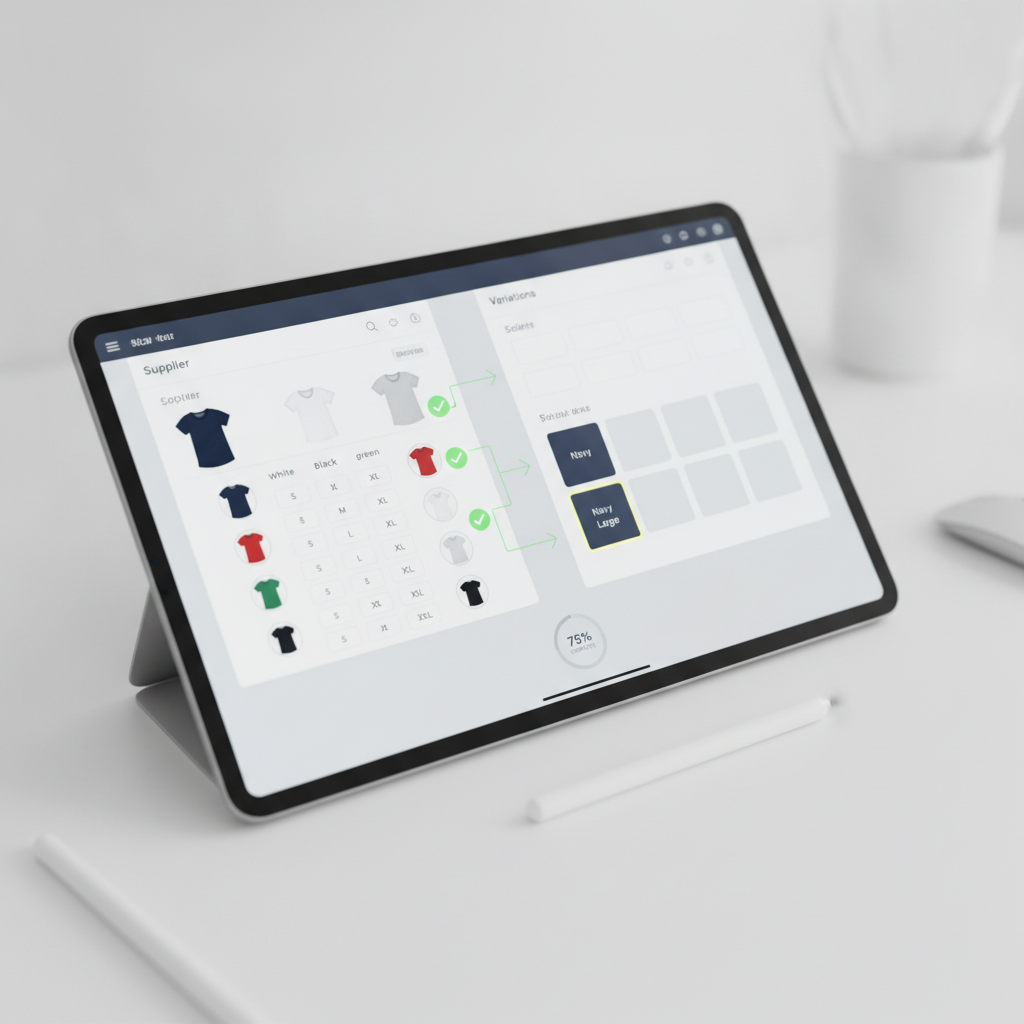
Single-item listings are relatively forgiving. You list one product, one price, one image set, and if something is wrong it's wrong for every buyer the same way. Variation listings don't work like that. Each size, color or configuration is its own mini-listing sharing a parent page, and every one of those mini-listings can be wrong independently. That's why multi-option listings generate a disproportionate share of returns and "not as described" cases for dropshippers — not because variations are inherently risky, but because they multiply the number of small decisions that need to be correct before publish.
Why variation listings carry more risk than single-item listings
When a seller builds a single-item listing, there's one image gallery, one price, one set of item specifics to get right. A variation listing might have six, ten, or twenty combinations of size and color, each needing its own correct image, its own correct availability, and sometimes its own price if the supplier charges more for certain sizes or configurations. If a seller copies the supplier's dropdown menus directly — every size the supplier's website lists, every color shown in a swatch — without checking which of those options are actually orderable right now, the listing goes live with phantom inventory baked into the structure.
The common failure points are predictable: an image assigned to "blue" that's actually a photo of the gray version, a size that the supplier discontinued last month but still shows in a dropdown, or a price that's identical across all variations when the supplier actually charges more for XXL. None of these show up as an error on eBay's side. The listing publishes fine. The problem only surfaces when a buyer picks the wrong-looking option and gets a product that doesn't match.
What to verify on the supplier side before building the variation structure
Before touching eBay's variation builder, the supplier page deserves a slower pass than most sellers give it. Three things matter most: which options genuinely exist right now, which of those are currently in stock rather than just listed, and where the price actually shifts between options rather than staying flat.
Suppliers frequently list a full range of sizes or colors as a matter of catalog completeness, even when half of them are backordered or discontinued. A dropdown showing eight colors doesn't mean eight colors are buyable today. Checking each option individually — even if that means clicking through variants one at a time — is tedious, but it's the difference between a variation listing that reflects reality and one that's built on the supplier's aspirational catalog.
Price is the other detail that gets skipped. Many multi-option products aren't priced flat across variations. A supplier might charge a few dollars more for larger sizes, extended warranties, or bundle configurations. If that price difference gets flattened into a single eBay price across all options, the seller either eats a margin loss on the larger sizes or overcharges on the smaller ones — and either way, it wasn't a deliberate pricing decision, it was an oversight from copying too quickly.
Matching images, prices and item specifics per option instead of copying blindly
The actual build step is where the risk gets locked in or avoided. Each variation needs its image tied to the correct option, not just any image from the supplier's gallery assigned in whatever order they happened to download. This sounds obvious, but on a listing with ten color options, it's easy to have the sixth and seventh image swapped and not notice until a buyer does.
Item specifics deserve the same option-level attention. Generic or copied-over specifics — a material field that says "as shown," a size field left blank, a color field that doesn't match the actual variation — don't just look sloppy. They contribute to how complete and trustworthy a listing appears to a buyer comparing options, and incomplete specifics can make an otherwise strong listing feel unfinished next to a competitor's. Item specifics support listing completeness and buyer confidence; they're not a lever that guarantees more visibility or sales, but a listing that's vague on basic details like size, color or material is working against itself before a buyer even gets to price.
A workable pre-publish check, run before hitting list rather than after:
- Every variation option shown on the supplier page has been confirmed in stock, not just present in a dropdown
- Each variation's image actually matches the option it's attached to, not the neighboring one
- Price differences between options (if the supplier has any) are reflected, not flattened
- Item specifics are filled per variation where they differ — size, color, material — not left as a single generic value copied across all options
- Any option the supplier shows as backordered or "notify me" is excluded from the eBay variation structure entirely
This is the kind of check that takes a few extra minutes per listing and prevents a return, a mismatch complaint, or a stock cancellation weeks later. Dropeex fits into this stage as a non-API eBay lister that keeps the connection between supplier product data and the eBay variation structure visible while a seller is building the listing, rather than requiring the seller to reconstruct the mapping manually every time and hope nothing got crossed.
Monitoring stock and price at the variation level, not just the product level
Once the listing is live, the risk doesn't go away — it changes shape. Suppliers update stock and price at the individual option level, not just the product level. A supplier can run out of the size that happens to be the listing's bestseller while every other size stays available. If a seller is only checking whether "the product" is still in stock, that kind of partial stock-out gets missed entirely, and orders keep coming in for a size that can't be fulfilled.
Price changes behave the same way. A supplier might raise the price on one configuration and leave the rest untouched. A seller monitoring at the product level, checking one representative price and assuming it holds across all variations, can end up selling several sizes at a loss without realizing which specific option triggered it.
This is where monitoring needs to match the structure of the listing. A variation listing needs variation-level monitoring — tracking each size or color's stock and price independently, not a single check that stands in for the whole group. Dropeex's supplier monitoring is built around this kind of per-option tracking, so a price or stock shift on one variation surfaces as a specific, actionable flag rather than getting buried inside a "still available" status for the product as a whole.
Keeping variation structure consistent as the catalog grows
The accuracy problem gets harder, not easier, as a seller adds more multi-option products. Doing this pre-publish check manually for five listings is manageable. Doing it for fifty, each with its own set of sizes, colors and per-option prices, turns into the kind of repetitive work that gets rushed, and rushing is exactly what causes mismatches in the first place.
The fix isn't to skip the check as the catalog grows — it's to keep the variation-building process consistent so the check happens the same way every time instead of depending on how careful a seller feels that day. A repeatable workflow for mapping supplier options to eBay variations, checking stock and price per option, and monitoring each variation after publish scales a lot better than doing it from memory. That consistency is the practical reason to treat variation accuracy as a workflow question, not just a one-time diligence exercise on a single listing.
If you're maintaining a run of multi-option listings right now, it's worth pulling up a handful and checking them against the list above — not the whole catalog at once, just enough to see where the gaps are. From there, building a cleaner eBay dropshipping workflow with Dropeex around variation structure and per-option monitoring is a reasonable next step for keeping that accuracy consistent as more products get added.
Do item specifics affect eBay search ranking?
Complete, accurate item specifics support listing completeness and help buyers compare options confidently. They're not a guaranteed ranking or sales lever, but a listing with vague or missing specifics is working against itself compared to a well-specified competitor.
Should I list every size or color a supplier shows, even if some are backordered?
No. Options that are backordered or unavailable on the supplier side shouldn't be added to the eBay variation structure at all, since they create phantom availability that leads directly to cancellations once an order comes in.
How is monitoring different for a variation listing versus a single-item listing?
A single-item listing needs one stock and price check. A variation listing needs that same check run per option, since suppliers update stock and price at the individual size/color/configuration level, not just at the product level.
